

Startup accelerators love to teach founders the hard stuff. Customer discovery. Fundraising. Unit economics. These are important skills that show up on a syllabus because they’re measurable and they feel urgent.
But hard skills are only half the equation. And the half that’s getting commoditized fast. Nearly anyone can whip together a go-to-market strategy, a business plan, and a working product with AI in a couple of days (maybe a couple of hours now). When the technical barriers to starting a company fall this dramatically, the question stops being can you build it and starts being can you lead it.
Not leadership in the corporate training seminar sense. Leadership as in: when things go sideways, how do you respond? When your team is stuck, do you take over or do you listen? When you’re under pressure, can you organize people and make decisions without a playbook?
Where We Are
We opened class the usual way, each sharing one win from the week and one roadblock experienced. Then I told everyone we were starting with a team-building exercise. A brain teaser to warm up. Nothing more.
What I didn’t tell them was that the exercise was the lesson.
We split into four teams and handed out a riddle (see below) — a logic puzzle with 15 clues, five categories, and one missing answer. Each team could only designate one person to hold the pen and paper, so before anyone could start solving, they had to decide who controls the board. That selection process alone was revealing.
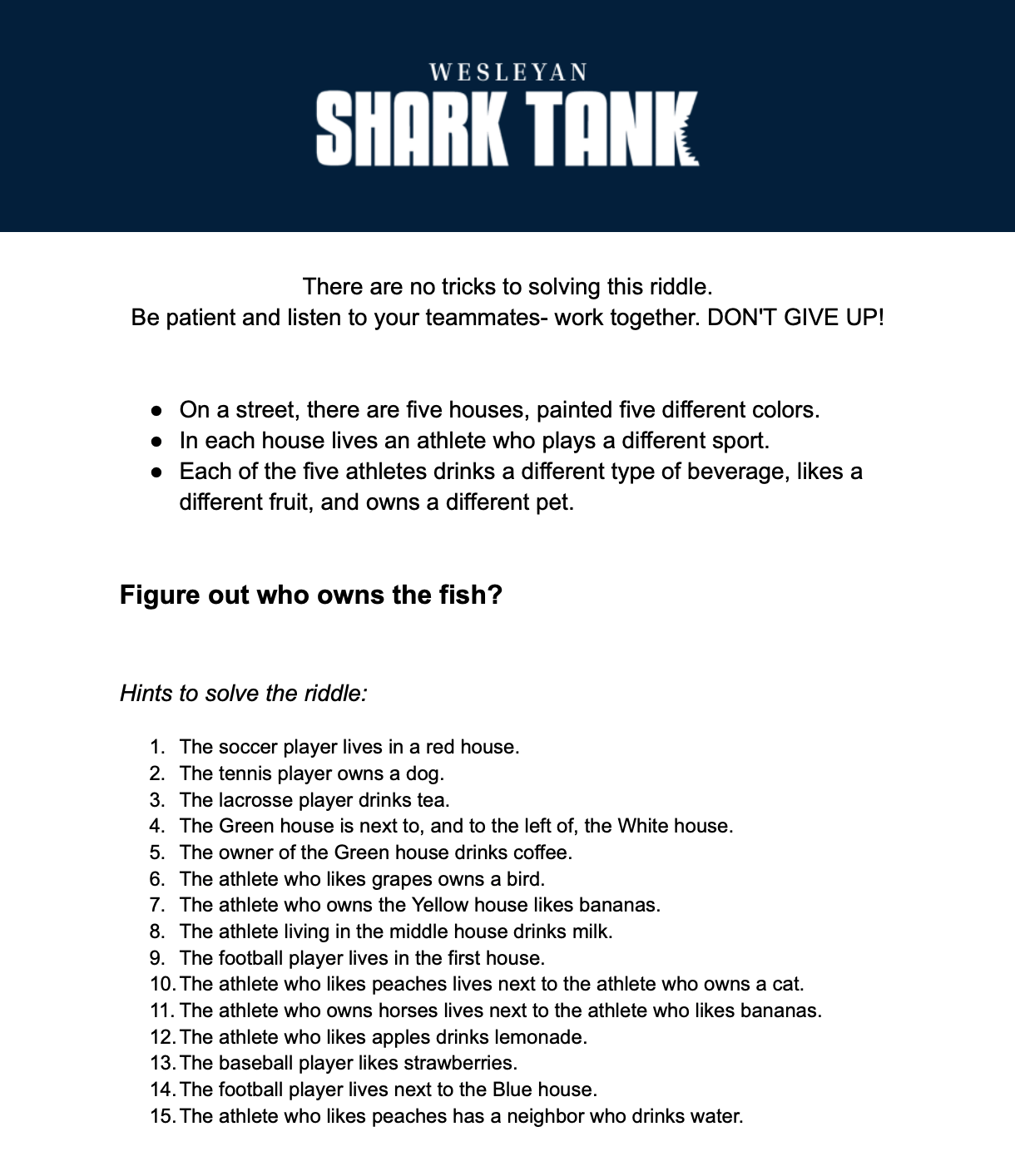
The groups competed for a priceless prize: pride. The first team solved it in 16 minutes. Two teams finished around the 30-minute mark. One team didn’t finish. We had to call it after an hour.
After the timer stopped, we revealed what the exercise actually was. This wasn’t a warmup. It was a leadership diagnostic. Palmer and I watched to see who took charge and who deferred. Whether teams divided the clues or tried to brute-force them together. How people responded when they hit inevitable adversity.
The true value of the class was in the discussion that followed. We connected those behaviors back to each founder’s experience running their own venture. The dynamics that played out over a logic puzzle — how you organize, how you delegate, how you make decisions when the answer isn’t obvious — those are the same dynamics that play out every day when you’re building a company.
Professor Tim Nguyen
From there, we brought in Professor Tim Nguyen. He teaches the growing category of classes at Wesleyan called Organizations and Society. His classes cover big data and responsibility, capitalism and its criticisms, and business ethics.
The discussion centered on a research article titled “A Garage and an Idea: What More Does An Entrepreneur Need?” by Pino Audia that argues the missing ingredient for most entrepreneurs isn’t an idea or technical skill — it’s organizational experience.
The popular narrative in entrepreneurship idolizes the garage founder. The best startup success stories come from scrappy founders building future billion dollar businesses like Walt Disney or Steve Jobs, who dropped out and built Apple from his parents’ house. But the data tells a different story. The majority of successful entrepreneurs come from organizations where they picked up three things: confidence, information, and community.
This was provocative for our class, because none of these students have big corporate experience and most of them don’t plan to. They’re not going into consulting or investment banking after graduation. They’re building companies now and aspire to continue doing so after graduation.
Nelson Bellows pushed back directly. Why would an analyst sit in a chair and crank out Excel models for 16 hours a day when Claude can finish it in 10 minutes? Is that manual grind still valuable, or is it an outdated prerequisite that AI has made irrelevant?
It’s a real question. If the traditional path to developing leadership skills was through years of reps inside big organizations, and AI is compressing or eliminating a lot of those reps, then where does leadership development come from? Feel free to chime in the comment section with your take:)
The dialogue in class was healthy and grounded in genuine curiosity about a cultural shift in career pathways. When coordinating this lesson, it was intentional to include a contrarian perspective. Our founders are ambitious and confident — they should be. But they're also college students, and compared to a seasoned executive or serial founder, they have less mileage. A big part of what we do here is expose students to perspectives and frameworks that push back on their instincts, so that confidence doesn't turn into blind spots. Ambitious and grounded can coexist. That's the founder we're building toward.
Beyond the Classroom
There’s a broader shift happening that makes this conversation more pressing than it might seem on the surface.
The 2026 Edelman Trust Barometer — which surveys nearly 34,000 people across 28 countries — found that trust in business sits at 64%, while trust in government has fallen to 53%. Business has been more trusted than government every year since Edelman started tracking this comparison and that gap does not appear to be closing.
When trust migrates from traditional institutions to businesses, the people running those businesses inherit a responsibility that didn’t used to come with the job. Founders who plan on leading successful businesses are no longer just building products, they are also becoming leaders that people look to. Whether it is a pandemic, social movement or political crisis — the spotlight finds the CEO now, and stakeholders expect them to stand in it.
This is something we think about a lot at Wesleyan Shark Tank. Beyond learning how to pitch, we aim to build the kind of well-rounded, interdisciplinary thinkers that this moment demands. Wesleyan has always taken pride in shaping people who can think critically across disciplines and that liberal arts approach to leadership is becoming more valuable, not less, as AI handles more of the technical work. The founders who stand out won’t just be the ones who can build the best product. They’ll be the ones who can lead, communicate, and earn trust.
Coming Up
We’re off for two weeks for spring break. Our founders have earned a well-deserved break (although most of them are more excited to have two weeks to focus on their company without school). We have a lot planned for the second half of the semester.
Most importantly: We have locked in our final event date and venue! May 4th from 7–9 PM at Kaufman Music Center (129 W 67th St, New York). Networking reception kicks off at 6 PM. More details to come, you won't want to miss this.
Watch the Recap
🎥 Episode 6 HERE
Get Involved
🦈 Shark: Join our investor panel at the NYC event
🤝 Mentor: Meet with a student founder (30 min, remote)
📈 Investor: Get connected with our founders
Interested? Email me: mastorino@wesleyan.edu
To infinity and beyond,
Michael Astorino