

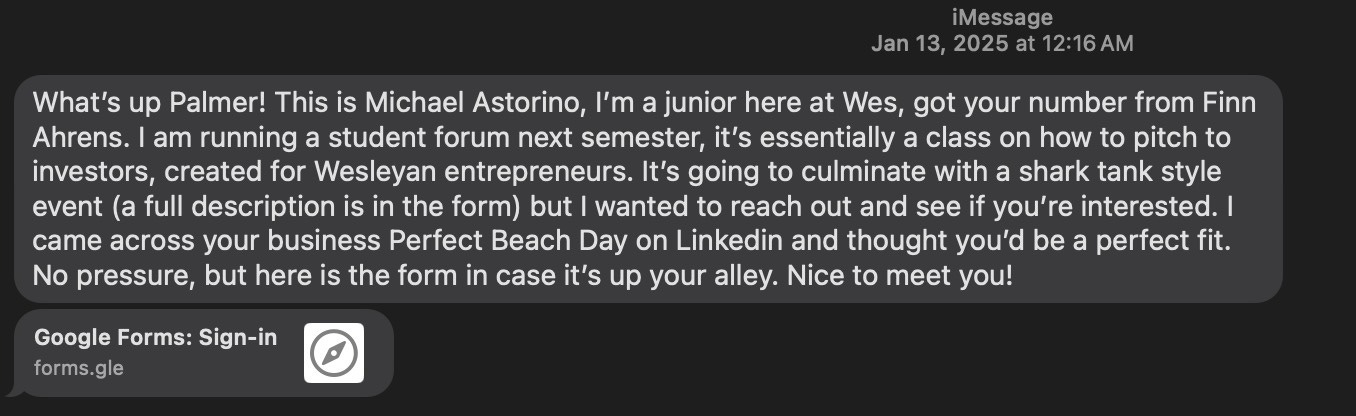
Last year, I received a text from an unknown number over winter break asking if I wanted to join something called “Wesleyan Shark Tank.” Transparently, my first thought as a freshman was, “does this check off my gen-ed requirements?” Optimistic, I excitedly wrote back and expressed interest.
Twelve months later, I had scaled my company and sold it over the summer. I was mentored under Strauss Zelnick, CEO of Take-Two Interactive - who offered to work with me after watching my pitch at our final event. The company I presented was Perfect Beach Day, an all-inclusive beach concierge service that employed 30 crew members across 12 beach towns on the Jersey Shore. I ran it for four summers. I arguably had the best office across any industry: the beach.
The spontaneous “yes” turned into the most meaningful experience of my time at Wesleyan. This year, I’m co-leading the program alongside Michael. Full circle is an understatement.
Throughout our countless meetings pitching Wesleyan Shark Tank to alumni, I’ve realized just how tight knit and committed the Wesleyan community is. The breadth of industries, impact, and creativity produced from this institution speaks to the caliber of people Wesleyan attracts. To any alumni reading this who we’ve connected with or who have supported this program in any way, thank you.
One standout example is Matthew Wheeler, Class of 2005, former lacrosse player (Go WesLax) - who founded SportsRecruits, the platform that became the go-to tool for high school athletes navigating college recruiting. It also just so happened to be the app I was recruited from to play at Wesleyan.
Where We Are
We began class with our traditional: One Win, One Roadblock, and One AI Use Case (building off of last class’s lesson). Matt shared that his AI use case was using ChatGPT as his sommelier for his wife’s surprise birthday party - creative.
Michael and I design our curriculum to build progressively each week. Last week, we focused on WHO our founders are targeting, by building detailed customer personas. This week, we focused on HOW we are reaching them in a go-to-market workshop. The lesson was mapped using the Bullseye Framework from Gabriel Weinberg’s, Traction.
Weinberg explains there are 19 possible channels to reach your customers - everything from SEO to community building to cold outreach - and most founders default to the two or three they’re most comfortable with instead of testing what actually works. The framework forces you to brainstorm all 19, narrow to your top 3 based on where your customer actually spends time, and then go all-in on one to test first.
After identifying their top three channels, students drafted one real piece of outreach - a cold email, a LinkedIn post, a community forum intro - for their primary channel. Homework: send it before next class.
Matt Wheeler '05
We welcomed Matt for his workshop on funding a startup. Matt addressed the question every founder must eventually confront: where is the money coming from, and what does it cost you?
He and his partner, Chris Mead, raised a total of $2.2M across the entire life of SportsRecruits. They were acquired by IMG Academy last year. Matt emphasized his bootstrapped approach and that at the end of his sale, he and his partner Chris were able to call their shots and walk away with a handsome payout. Matt is now CEO of Clipp’d, an AI-powered highlight reel platform for golfers.
Of the 5.2 million businesses started in 2024, only 3,600 received VC seed funding. That’s less than 1 in 1,000. And of those VC-backed companies, 75% fail to return capital to their investors.
Matt emphasized that capital is never free. You either pay with interest (debt) or you pay with ownership (equity). Every dollar has a cost, and the default assumption in 2026 that you need to raise venture capital is, statistically, wrong.
Matt broke down the reality of VC and the funds that are raised in order to pay out their LPs. A VC has a $100M fund. They take 20% of your company. For your company to “return the fund,” you need to exit at $500 million. So if you sell for $50M, a life-changing outcome for most founders, the VC gets $10M back. To them? That’s a failure.
Alternatively, for the same $50M exit. If you bootstrapped and still own 80%, you take home $40M. If you went the VC route and own 20%, you take home $10M. Same exit price but an entirely different narrative.
Matt was not anti-VC – rather, he was helpful in informing students of their funding options so they can make a grounded decision on where they fundraising come from.
The Litmus Test
Before our founders pitch the Sharks on April 27th, Matt told them to sit with three questions:
Is the market huge? Can this realistically be a billion-dollar company? If your TAM is under $50M, VC probably isn’t your lane.
Do you actually need the cash? Are you building hardware or biotech? Or can you sell version 1.0 tomorrow?
The ego check. Do you want to be famous - TechCrunch headlines, conference keynotes - or do you want to be wealthy and free?
Coming Up
Week 4: Louise Astorino (∫Forbes 30 under 30) of Not An Ad and Yuchao Wang ‘25 (Former Wesleyan Shark Tank student) of HCC Popups join us for a marketing masterclass. We’ll cover the essentials of building a personal brand through social media strategy, organic growth, and content pillars. Louise will share the frameworks she used to land Domino’s as a client and lead their marketing campaign.
Watch the Recap
🎥 Week 3 Episode HERE
Get Involved
🦈 Shark: Join our investor panel at the NYC event (late April)
🎤 Guest Speaker: Lead a session on your expertise
🤝 Mentor: Meet biweekly with a student founder (30 min, remote)
📈 Investor: Get connected with our founders
Interested? Email mastorino@wesleyan.edu
Cheers,
Palmer