

Last week, I walked across the graduation stage next to Foss Hill in the pouring rain and my career as a Wesleyan student came to a close. As the post-graduate days go by, the most common question I’m asked is: “how do you feel now that you’re done?”
I’ve been saying the typical answer of “bittersweet” and “ready to go, but sad to leave’, the classics.
But, upon some deeper introspection, I feel an immense amount of pride and gratitude.
When I first arrived at Wesleyan, I seriously considered transferring because I originally committed here under two criteria: 1) a good education and 2) a good basketball program.
Naturally, after finding out Wesleyan didn’t have a business program or even a class with the word ‘business’ in it, I had serious concerns about what I would do for four years here.
However, the silver lining in this (and why I speak so highly of this place), was that I’ve had the opportunity to be a part of creating the systems that I had wished existed when I got here.
As I got closer to holding that diploma and saying goodbye to Middletown, CT — I spent a great deal of time thinking about how to ensure these systems outlast me here and continue to build off of the momentum we have created.
So consider this a guide. To the future leaders of this program, to the alumni who care about entrepreneurship at Wesleyan, and to anyone at the university thinking about what this could become. I’m sharing my framework not as a finished product, but as a starting point.
The Wesleyan Entrepreneur
I want to start with a concept I’ve been calling mindful entrepreneurship.
To me, the student who is pursuing a career as a videographer or artist is just as much an entrepreneur as a climate solution NGO builder or somebody starting a B2B software company. Entrepreneurship, at its core, is problem-solving. It’s identifying something in the world that needs to be different and actually building toward that change. It doesn’t belong to any one discipline.
And that’s exactly why it belongs at Wesleyan.
Part of the beauty of the open curriculum is that students can gain a wide breadth of skills across disciplines and then can turn them into actionable solutions while they’re still at school. The government major who understands policy and builds a civic tech platform. The film student who launches a production company. The biology major who develops a medical device. These are natural outputs of a school that teaches you to think across boundaries.
Mindful entrepreneurship is the Wesleyan entrepreneur. It’s the recognition that entrepreneurship isn’t just tech bros in hoodies chasing venture capital — it’s interdisciplinary, it’s thoughtful, and it’s the ultimate expression of taking theory and turning it into action.
Founders are the catalysts for progress in this world. If schools like ours take pride in shaping these types of problem solvers, then entrepreneurship is that thesis coming to life.
The Framework
I’m a marketing person by nature, so I think about things in funnels and user journeys. When I attempted to map Wesleyan’s entrepreneurship ecosystem onto a single framework, what I landed on looks like a dual funnel, that just so happens to be shaped like a “W”:
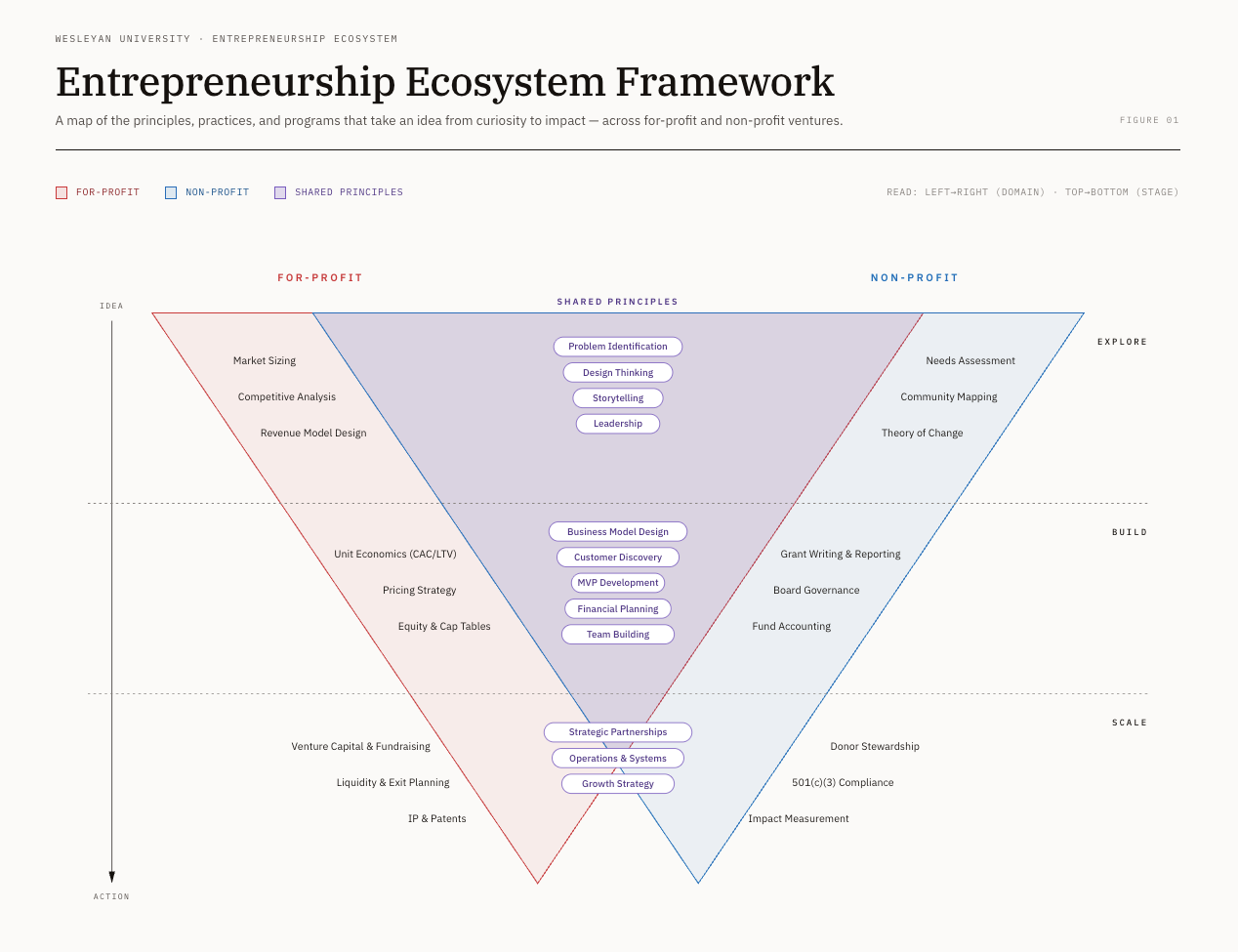
Two things are happening at once. Horizontally, the framework maps the spectrum from for-profit to non-profit. Vertically, it maps the journey from idea to action — from exploring entrepreneurship to actually building something. The greatest way to learn is in the act of doing it.
The key insight is that the overlap between for-profit and non-profit entrepreneurship is far larger than most people assume. The real distinctions are structural and legal, not operational. Things that feel different but are actually the same skill with different vocabulary.
Take fundraising. A for-profit founder pitching a VC and a non-profit founder pitching a major donor are doing fundamentally the same thing — making a compelling case for why someone should give them money based on a vision of future impact or return. The mechanics differ (term sheets vs. grant agreements, equity vs. tax deductions), but the core muscle is identical: storytelling, credibility building, relationship management, follow-up. The same is true of “customers” vs. “beneficiaries” — customer discovery and beneficiary research are the same discipline. Financial planning is financial planning whether your revenue comes from sales or grants. Growth strategy is growth strategy whether you’re scaling a product or a program.
Where the two sides genuinely diverge is in their structures. For-profit ventures deal with equity ownership, cap tables, venture capital mechanics, and exit planning — concepts that don’t exist in the non-profit world. Non-profits have their own technical requirements: 501(c)(3) compliance, fund accounting, grant reporting, and formal impact measurement frameworks. Those differences are real, but they’re specialized knowledge that only becomes relevant further down the funnel.
That center overlap — problem identification, business model design, customer discovery, team building, financial planning, storytelling, pitch development, operations, growth strategy — is where the foundation gets built. And it should be built together. The Patricelli Center recently dropped “Social” from its name, and this framework reflects why: the center’s greatest strength is in that shared ground where the principles of entrepreneurship apply regardless of business model.
The 3 C’s
Everything in the ecosystem maps onto three pillars: Community, Capital, and Curriculum. Each one has its own placement on the triangle funnels.

Community is how students find their way in. The Entrepreneurship Club and the PCE are the widest entry point — open to everyone, no prerequisites. As you go deeper, the community gets more intentional and relationships deepen. This fall, we launched Startup Table — a series of lunches organized around specific domains like women in entrepreneurship, media and film, and consumer products. Out of exploration phase, now you find your people. At the bottom of the funnel, community becomes accountability. A cohort like Wesleyan Shark Tank, where ten founders spend a semester building alongside each other, or the Digital Wes alumni network, where you’re connecting with graduates who’ve actually done this.
Capital starts small and scales with commitment. A $500 microgrant is enough to buy software or prototype materials — low barrier, high accessibility. The Summer Grant gives students runway to work full-time over the summer. And at the bottom, the major awards: the Davis Peace Prize at $10,000 on the non-profit side, the New Venture Award at $8,000 for both domains, and Shark Tank’s capital for for-profit ventures. Eventually, I’d like to see a dedicated fund specifically for investing in student/alumni ventures. We’re not there yet, but the groundwork is being laid.
Curriculum is where the pipeline is most visible. A student can walk into Marisa McClary’s Intro to Entrepreneurship as a freshman without a product or even an idea. That class gives them the thinking and the frameworks for becoming an entrepreneur. From there, they can move into Rosemary Ostfeld’s Startup Incubator, which takes them from idea to minimum viable product. And if they’re ready, they can apply to Wesleyan Shark Tank, which is built for founders who are past the idea phase and working toward market, scale, and investment. That pipeline — from exploration to action — didn’t exist as a connected path four years ago. It does now.
Looking Back (and Forward)
Over the past four years, I’ve had a front-row seat to the evolution of Wesleyan’s entrepreneurship ecosystem. I’ve watched it grow from a center in the basement of Allbritton — an office the size of a closet — to a real space on the second floor with programming, community, and curriculum that didn’t exist when I got here as a freshman. I’ve interacted with nearly every corner of it: the Patricelli Center, the Entrepreneurship Club, the Career Center, the alumni network, the courses, the grants, the people.
This community shaped me. Alumni who were generous with their time and insights. Fellow student-founders who inspired me to be the best version of myself. Mentors who guided me through the rollercoaster of entrepreneurship. I'm proud of what we've built together, and forever grateful for the people who made it possible.
Which brings me back to why I wrote this in the first place. This piece was never meant to be a victory lap. It's meant to be useful, a reference point for the people who will carry this forward and make it even better.
This is a framework, it’s not a finished product. It probably never will be. There are things I’m probably missing — things that someone with longer institutional memory or a different vantage point would see that I can’t. I’ve been here four years. That’s deep enough to see patterns, but not long enough to see everything. There have been several people before me who have created the systems that I have built off of and deserve more credit than I do.
So this is an open invitation. To the alumni who laid the groundwork, administrators who’ve watched this evolve over decades, students who are going to lead this next, really anyone with an opinion on this matter. I would love to hear your thoughts, suggestions and feedback.
Because the pipeline is real now. The question isn’t whether Wesleyan has an entrepreneurship ecosystem — it does. The question is what it becomes next.
With pride and gratitude,
Michael
PS - We released our final YouTube video for Wesleyan Shark Tank. An exclusive behind-the-scenes look at what it took to put our finale together. I suggest giving it a watch, it beautifully captures how all the chaos comes together. Watch it HERE.
PPS - wesleyansharktank.com is live! Check it out to see everything we built and how to get involved next year.
Inspirational reading and impressive progress in evolving entrepreneurship at Weslayan!